
A professional Doctor Hiring Consultancy usually starts by understanding the hospital's exact requirement, identifying where suitable specialists are likely to be available, searching existing medical talent networks, approaching passive doctors, screening profiles against clinical and career requirements, and coordinating discussions until both the hospital and doctor see a workable fit.
For difficult specialties or locations, the search often becomes a targeted talent-mapping exercise rather than a conventional job-posting exercise.
Why Specialist Doctor Hiring Is Different From Regular Recruitment
Hospitals do not simply need an employee. They need a medical professional whose education, specialty, clinical exposure, registration, experience and availability match the responsibilities of a specific department.
Consider the difference between recruiting an administrative executive and recruiting a consultant radiologist.
For an administrative role, several candidates may possess transferable experience.
For a radiologist, however, the search may depend on questions such as:
Does the doctor have MD, DNB or an appropriate postgraduate qualification?
Does the hospital require independent USG exposure?
Is CT or MRI reporting part of the role?
Is the doctor comfortable managing the expected workload?
Does the professional hold or qualify for the required registration?
Is relocation possible?
Does the compensation match the doctor's expectations?
When can the doctor actually join?
The number of potentially suitable professionals becomes smaller each time another genuine requirement is added.
This is why specialist recruitment depends more on precision than volume.
Sending 50 loosely matched CVs may create more work for a hospital HR team. Finding five doctors who genuinely match the role can be significantly more useful.
How Does a Doctor Hiring Consultancy Find Specialist Doctors?
A specialist search normally works through several channels simultaneously.
There is rarely one website, database or job portal containing every suitable candidate.
An experienced recruitment team gradually builds what can be called a medical talent map: a working understanding of which doctors practice particular specialties, where they currently work, what type of hospital environment they prefer, whether they are considering a change and what conditions could make relocation realistic.
The process can broadly be divided into seven stages:
Requirement diagnosis
Specialty mapping
Existing database search
External and referral sourcing
Direct doctor outreach
Screening and matching
Interview and joining coordination
The strength of the process is not simply where doctors are found. It is how the consultancy converts a large pool of medical professionals into a relevant shortlist.
Step 1: The Search Begins With Understanding the Hospital, Not Searching CVs
One of the biggest recruitment mistakes is starting the candidate search before defining the vacancy properly.
Suppose a hospital says:
"We need a cardiologist."
That is not yet a complete search brief.
The recruiter needs to understand whether the hospital requires a non-invasive cardiologist, interventional cardiologist, consultant cardiologist, full-time specialist or visiting consultant.
The conversation should then go deeper.
A Useful Doctor Requirement Brief Should Clarify
Requirement Area | Questions the Recruiter Should Understand |
Specialty | Which exact specialty or sub-specialty is required? |
Qualification | Which postgraduate/super-specialty qualifications are acceptable? |
Experience | Is independent experience required? |
Clinical Scope | What procedures or responsibilities will the doctor handle? |
Hospital Infrastructure | What facilities and equipment are available? |
Patient Load | What type and approximate volume of cases can the doctor expect? |
Duty Structure | OPD, IPD, emergency, on-call or fixed duty? |
Compensation | Fixed salary, incentive, revenue sharing or combination? |
Location | Is relocation necessary? |
Accommodation | Is accommodation or relocation support available? |
Joining | Immediate requirement or flexible joining date? |
Growth | Department expansion, leadership or long-term opportunity? |
This initial discussion determines how the search will be conducted.
For example, a hospital requiring an interventional cardiologist for a functional cath lab needs a completely different pool from a facility seeking a physician with cardiology exposure for OPD consultations.
This is also where a broaderHealthcare HR Consultancy approach can add value. Instead of treating recruitment as an isolated vacancy, the consultant can understand workforce planning, department requirements, role clarity and retention factors together.
Step 2: Build a Specialty-Specific Candidate Map
Once the requirement is clear, the recruiter decides where suitable doctors are most likely to be found.
This is where experience in healthcare hiring matters.
Different specialties behave differently in the employment market.
A search for a radiologist may require attention to diagnostic centres as well as hospitals.
A gastroenterologist search may involve professionals working in facilities with strong endoscopy infrastructure.
A CTVS surgeon or neurosurgeon search becomes even more dependent on hospital infrastructure, operative exposure and team support.
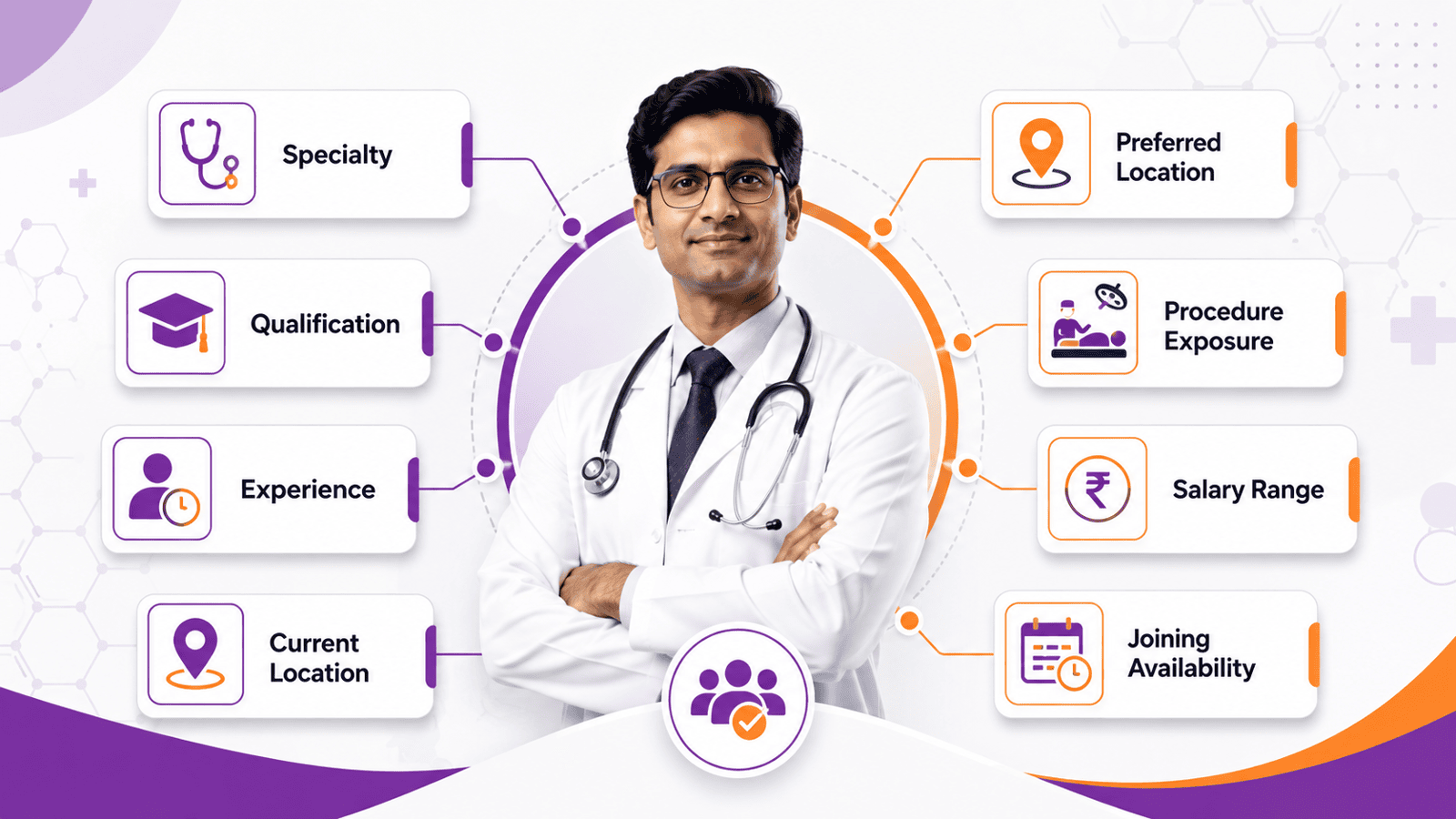
Rather than searching simply for a job title, recruiters start creating combinations such as:
Specialty + Qualification + Experience + Current Location + Preferred Location + Procedure Exposure + Salary Range + Joining Availability
That combination dramatically improves relevance.
It also explains why an experienced medical recruiter may uncover candidates who never applied to the hospital's advertisement.
Step 3: Search an Existing Healthcare Talent Network
A major advantage of a specialist recruitment company is accumulated candidate intelligence.
Over time, recruitment teams interact with doctors at different career stages:
doctors actively seeking a new role,
doctors who may move after completing a notice period,
professionals returning to their home state,
specialists considering better clinical exposure,
doctors interested in moving from a smaller setup to a larger hospital,
doctors who prefer a different location,
and passive professionals who may consider the right opportunity.
ANG Placement & Staffing Solutions focuses specifically on healthcare recruitment and states that it works with hospitals, diagnostic centres, nursing homes and medical colleges.
This specialist exposure matters because historical interaction can help recruiters understand much more than what appears on a resume.
A CV may tell you where a doctor worked.
A recruiter conversation may reveal why the doctor wants to move, when a change is possible and which opportunity would actually interest them.
That context is particularly important in Consultant Doctor Hiring, where the decision is often influenced by several professional and personal considerations rather than salary alone.
Step 4: Go Beyond Active Job Seekers and Reach Passive Doctors
This is one of the most important differences between ordinary recruitment and specialist search.
The ideal doctor may not be actively applying anywhere.
They may already be working in another hospital.
They may not have updated their resume.
They may not be checking job portals.
But they may still be open to a conversation if the opportunity offers something meaningful: better clinical exposure, higher responsibility, improved infrastructure, geographic preference, family proximity or professional growth.
That is when direct sourcing becomes important.
Recruiters may identify relevant professionals through established networks, professional platforms, referrals, previous conversations, databases and targeted outreach.
The first conversation should not feel like a generic sales call.
A useful discussion is more specific:
"Would you consider a hospital where you can independently manage the department?"
or
"The opportunity offers the procedure exposure you mentioned during our earlier conversation."
Step 5: Use Doctor Referrals as a Trust Network
Medical professionals operate within closely connected specialty networks.
A radiologist may know another radiologist completing a contract.
A surgeon may know a colleague planning to relocate.
A senior doctor may recommend a younger specialist looking for better exposure.
This makes referrals particularly useful in specialist recruitment.
But a referral is only the beginning.
The referred professional still needs to be assessed against the hospital's requirement.
Good recruiters therefore avoid assuming:
"Recommended doctor = right doctor."
Instead:
Referral → Conversation → Requirement Match → Screening → Hospital Evaluation
This keeps the process based on suitability rather than familiarity.
Step 6: Screen for More Than Qualification
Finding a doctor with the correct degree is only the beginning.
A meaningful screening conversation should examine several layers.
Clinical Fit
The recruiter needs to understand whether the professional's experience matches the responsibility.
For example:
independent clinical practice,
procedures performed,
equipment exposure,
OPD/IPD management,
emergency responsibilities,
team handling,
academic responsibilities,
department leadership.
Career Fit
Why is the doctor considering a change?
This question can uncover whether the new opportunity genuinely addresses the doctor's motivation.
Location Fit
A candidate saying "open to relocation" does not automatically mean every location is acceptable.
Recruiters should understand:
preferred states,
proximity to family,
spouse career considerations,
children's education,
city preferences,
connectivity,
accommodation needs.
Compensation Fit
Salary discussion should happen early enough to prevent avoidable mismatches later.
The recruiter should understand whether expectations include:
fixed monthly compensation,
incentives,
procedure-based earnings,
accommodation,
joining support,
leave structure,
other contractual considerations.
Availability Fit
When can the doctor realistically join?
An immediate hospital requirement may not align with a professional serving a long notice period.
Understanding this early saves time for both sides.
A Practical Specialist Doctor Matching Framework
A useful recruiter does not ask only:
"Is this doctor qualified?"
The stronger question is:
"How closely does this particular opportunity fit this particular doctor's professional and personal situation?"
An internal evaluation framework can help.
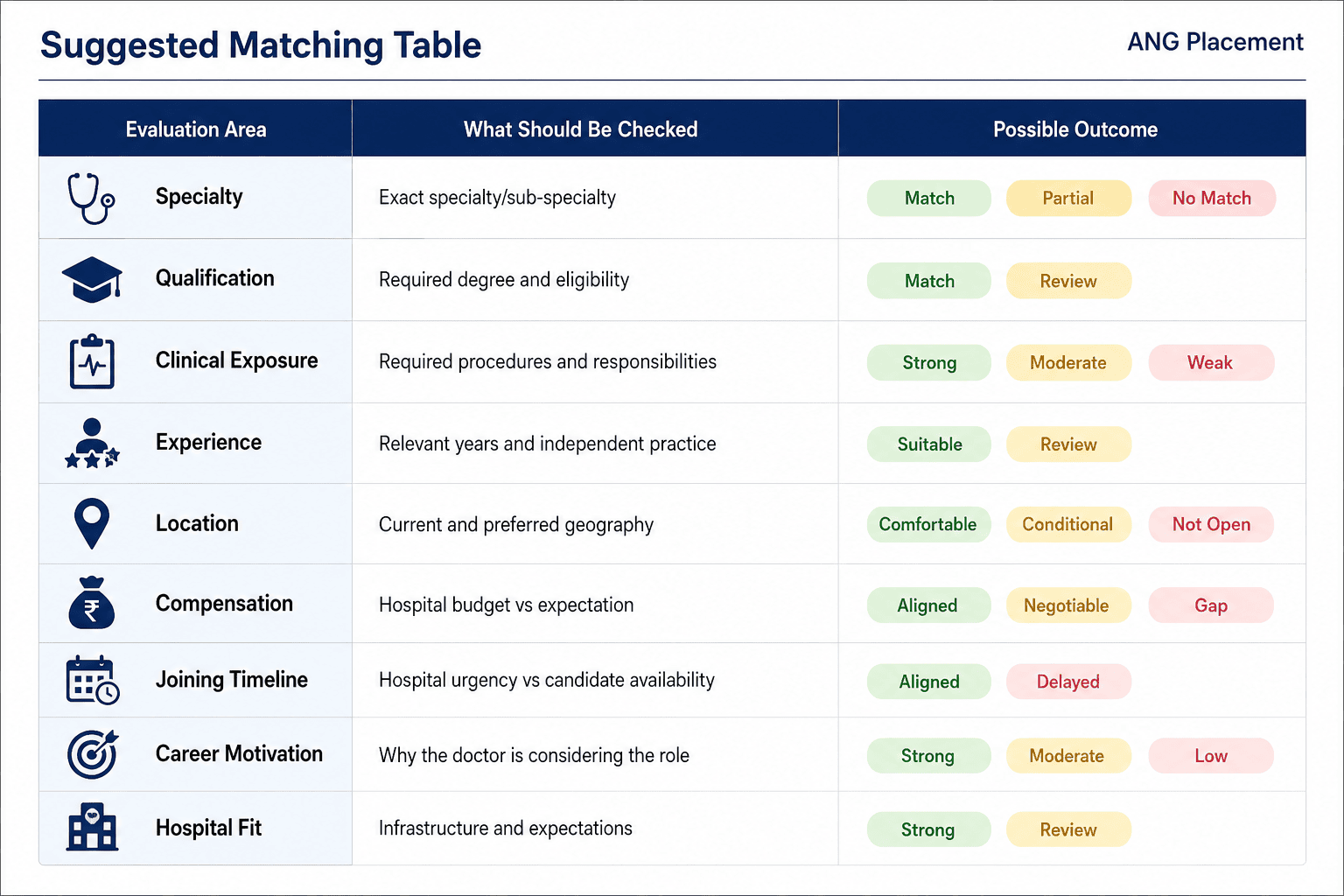
This kind of structured evaluation makes candidate submission more meaningful.
It also gives the recruiter a reason for recommending the profile rather than simply forwarding a CV.
Step 7: Present the Opportunity Properly to the Doctor
A surprising amount of recruitment success depends on how the job is explained.
Sending a message containing only:
"Radiologist required. Salary ₹X. Location Y."
does not answer the questions an experienced specialist may have.
A strong opportunity discussion should explain:
hospital type,
department setup,
available infrastructure,
role expectations,
clinical workload,
reporting relationship,
working schedule,
compensation structure,
location advantages,
accommodation if available,
expected joining date,
and professional growth potential.
The same principle works for hospitals.
Recruiters should present the doctor with enough context to explain why the candidate has been shortlisted.
When both sides enter the interview with realistic expectations, the conversation becomes much more productive.
Step 8: Coordinate the Interview Around Clinical Fit
Recruiter involvement should not end when a CV is shared.
The next stage is creating a useful conversation between the hospital and the doctor.
Depending on the role, that may involve:
HR discussion,
medical director discussion,
department head interview,
management round,
virtual interview,
hospital visit,
infrastructure discussion,
commercial negotiation.
For a specialist doctor, an interview should give both sides the opportunity to evaluate the match.
The hospital wants to understand the doctor's clinical suitability.
The doctor wants to understand whether the hospital can support the work they are being hired to perform.
That second part is sometimes overlooked.
For example, if a specialist is expected to perform procedures independently, they will naturally want to understand the infrastructure, support team and patient flow.
The recruitment process becomes stronger when these discussions happen before the offer is finalized rather than after joining.
Step 9: Solve the Offer-to-Joining Gap
Recruitment does not finish when the candidate says "yes."
The period between selection and actual joining can be one of the most sensitive stages.
A doctor may receive another offer.
Their current hospital may counter-offer.
Family circumstances may change.
Relocation may become difficult.
The joining date may be delayed.
A professional recruitment team therefore stays connected with both sides and looks for potential concerns early.
The objective is not to pressure the doctor.
It is to maintain clarity.
That means confirming:
offer terms,
joining date,
documentation,
relocation requirements,
notice-period status,
accommodation arrangements where relevant,
any unresolved hospital questions.
When communication disappears after selection, uncertainty increases.
What Matters Most When Matching a Specialist Doctor?
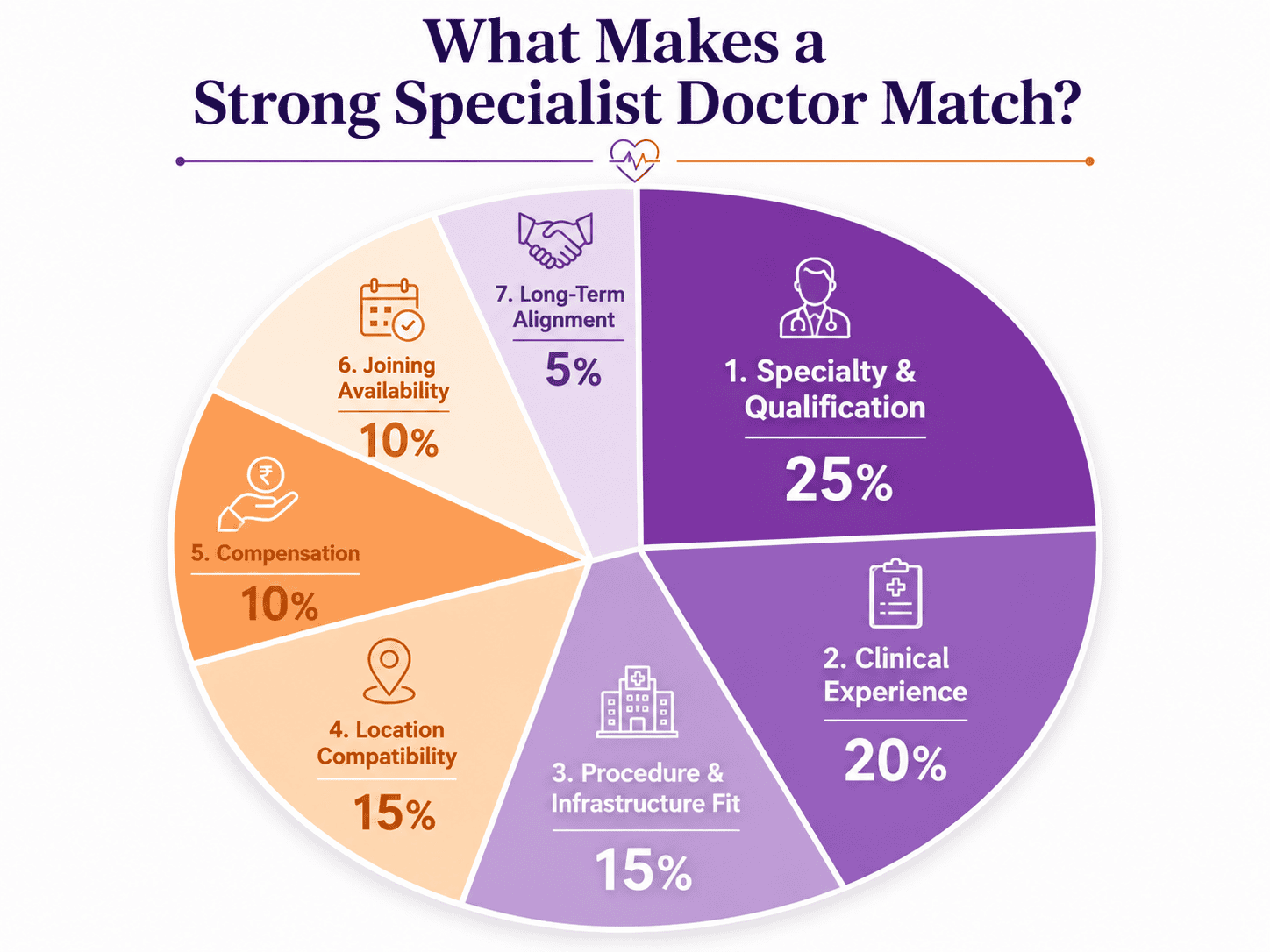
Not every factor carries equal importance for every role.
Instead of treating the following distribution as a universal industry statistic, hospitals can use it as a sample decision framework and modify the weightings for each vacancy.
Why Job Portals Alone May Not Be Enough for Specialist Hiring
Job portals remain useful, particularly when doctors are actively exploring new opportunities.
The limitation appears when the target candidate is not actively applying.
A hospital may need a very specific combination:
specialty + qualification + clinical skill + geography + salary alignment + availability
Once those filters are applied, the search pool can narrow quickly.
That is why specialist recruitment usually combines multiple channels rather than depending on one source.
When Should a Hospital Use a Doctor Recruitment Partner?
Not every vacancy requires external recruitment support.
A hospital with a strong internal talent pipeline may fill certain roles independently.
Specialist assistance becomes more valuable when the search becomes difficult, urgent or highly specific.
Common situations include:
the vacancy has remained open for a long period,
the specialty has a limited local talent pool,
the hospital is expanding a new department,
a doctor is required in a Tier-2 or Tier-3 city,
the desired candidate must have specific procedural exposure,
the internal HR team is receiving irrelevant applications,
several candidates have declined after selection,
the vacancy is confidential,
the hospital requires simultaneous hiring across specialties,
management needs stronger market intelligence before finalizing the offer.
A recruitment partner should complement the hospital's HR team not replace the hospital's responsibility for final clinical evaluation, credential verification, employment terms and statutory compliance.
Why Specialist Doctors Sometimes Say No Even to Good Offers
Hospitals sometimes assume that salary is the main reason a doctor accepts or rejects a role.
It is important, but it is rarely the only factor.
An experienced specialist may also evaluate:
Understanding these factors is why consultation is an important part of recruitment.
The recruiter is not simply asking whether a doctor "wants the job."
The recruiter is trying to discover what conditions would make the job genuinely workable.
Frequently Asked Questions
1. How does a doctor hiring consultancy find specialist doctors?
Through healthcare databases, doctor referrals, professional networks, job portals, previous candidate connections, and direct outreach to active and passive doctors.
2. How long does it take to find a specialist doctor?
It depends on the specialty, location, salary, experience required, and doctor availability. Clear requirements usually help speed up the process.
3. What information should a hospital provide before starting the search?
Hospitals should share the specialty, qualification, experience, clinical skills, salary, location, duty hours, infrastructure, accommodation, and expected joining date.
4. Why is specialist doctor hiring difficult in some locations?
Doctors consider factors such as hospital infrastructure, salary, patient exposure, career growth, family needs, connectivity, and relocation support before accepting a role.
5. What should hospitals check before hiring a consultant doctor?
Hospitals should verify qualifications, medical registration, clinical experience, procedural skills, employment history, references, and overall suitability for the role.